They asked about your service. You sent a helpful reply. Now the conversation has the energy of a plant you are not entirely sure is still alive. Do you send another message, give it time or stop hovering over the inbox?
To follow up after no response, remind the person what they asked about, add one useful detail and offer an easy next step. Use the timing and contact route they agreed to. If they need space, pause; if they ask you to stop, stop.
This guide is for a small team replying to an inbound sales enquiry before a quotation has been sent. The messages are original examples to adapt, not a cold-contact sequence or a promise that a quiet prospect will buy.
Before the message, choose the next move.
What did they actually say?
A message-writing guide. It does not read your inbox, score a lead or send anything.
No reply, “not now” and “no thanks” are three different situations. Treating them as one queue of people to chase creates work your customer did not ask for.
Choose the closest situation. The guide gives you an editorial starting point, not a score or an automatic messaging instruction. The six complete messages are just underneath.
6 sales follow-up messages after no response.
Pick the message that matches the actual conversation. Replace every bracket, keep the detail that helps and remove anything you cannot honestly say.
These examples assume an appropriate, permitted contact. A WhatsApp example is ordinary writing to adapt, not a Meta-approved Message Template. Check the channel rules before sending.
A little timing. Much less inbox hovering.
Start with the last agreement. “Please call Friday afternoon” is more useful than a sales blog telling you Tuesday is magical. The person has already given you the timing.
Where no date was agreed, give them a reasonable opportunity to read and respond during their business hours. Consider how much work your question asks of them. Choosing between two callback times is different from obtaining approval for a project.
Here is one deliberately small example for a non-urgent inbound service enquiry. It is a planning illustration, not a measured best cadence. A reply, a requested pause, a refusal or a channel restriction changes the plan.
| Example moment | Useful action | What changes it |
|---|---|---|
| Day 0 | Answer the original question and offer one clear next step. | Missing information may need a specific clarification first. |
| Around day 2 | If appropriate, send one concise nudge about the original request. | An agreed later date means wait for that date. |
| Around day 5 | Return only if you have something relevant to add or clarify. | No new value is a reason to avoid another empty chase. |
| Around day 10 | Consider closing the current outreach for now. | A request to stop means stop immediately, not after the schedule. |
Let Kibi remember the promise. You make the next move.
The awkward part is often not the wording. It is remembering who replied, whether a call was attempted and which day the customer actually asked for. That is a very practical reason to try Kibi CRM.
Keep the enquiry with its owner, latest interaction and planned next action. Today brings new enquiries, due follow-ups, overdue work and open enquiries without a next action into view. A person still makes the call or sends the message.
If Maya asks you to return next week, update the plan beside her enquiry. The covering teammate should be able to read the current promise before contacting her. Routing is included on Team and Growth; check the relevant roles and plan for the team you need.
The genuine Kibi demo screens below show a saved enquiry and an updated next action. The people and project details are fictional. They demonstrate the record, not a measured improvement in replies or an automated send.
Give Kibi a 14-day free trial, then choose a paid plan if it fits. Start with one fictional enquiry and ask another teammate to explain the next contact from the record. A much better first date than importing everything and hoping.
REAL KIBI SCREENS · FICTIONAL DEMO DETAILS
Keep the request where the team can find it
The saved enquiry shows Victoria’s service, budget, message and website-form source. These are fictional project details. 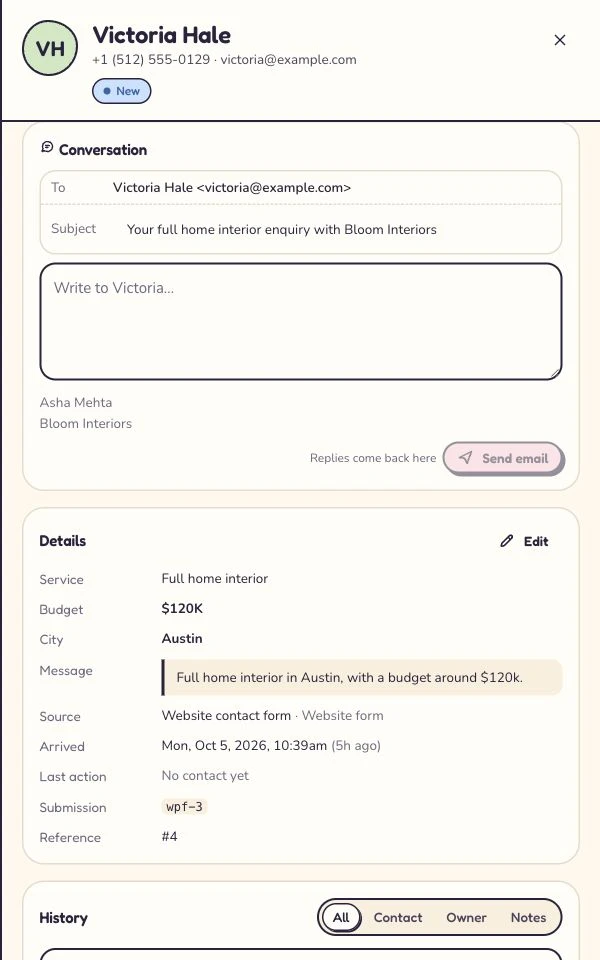
Make the changed plan easy to find
Asha is the owner; the next step is a call tomorrow at 10. This shows the updated record, not a test of another user’s access. 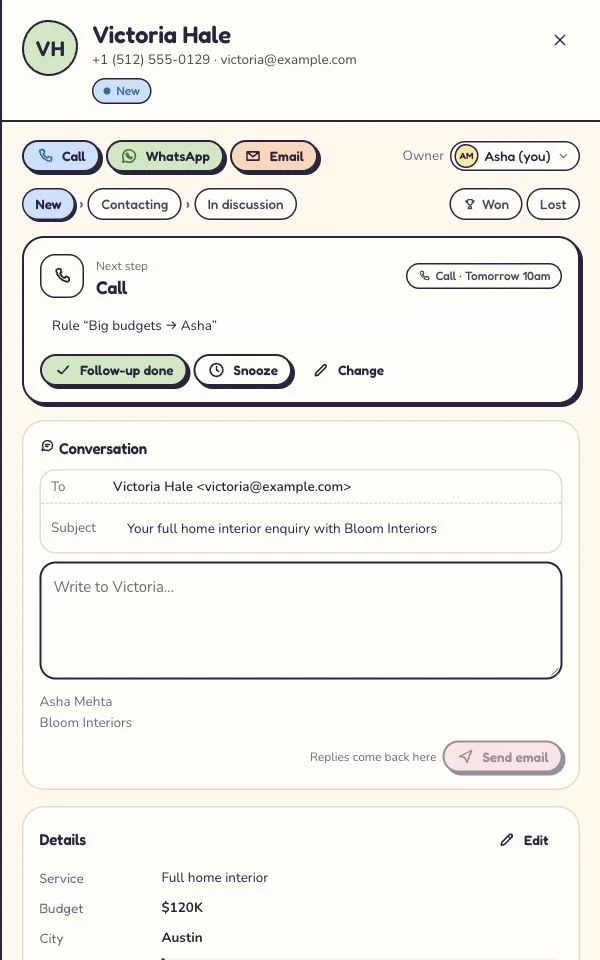
Captured 6 October 2026 in our isolated demo. Screens show different moments, not an automated sequence. Expand a step to see the screen.
A quiet enquiry is still a conversation, not a personality test.
Maya asks.
Ravi keeps the thread.
1An enquiry, still finding its shape+
Maya asks about a studio website refresh.
- Latest context
- Ravi has replied and asked whether copywriting is needed.
- Next human action
- One useful scope question, if contact is appropriate.
2The customer changes the timing+
“Could you come back next week?”
- Latest context
- Ravi records the requested pause beside the enquiry.
- Next human action
- Return at the agreed time, rather than keep nudging now.
3A colleague covers the next contact+
The owner and latest agreement stay visible.
- Latest context
- The covering teammate reads the current record before replying.
- Next human action
- Make the contact, record the outcome and agree any further action.
A coded teaching illustration, not a live workspace or an automatic sequence.
Here is a fictional agency enquiry: Maya asks about refreshing her studio website. Ravi answers, then asks whether she needs copywriting as well as the build. There is no quotation yet; the scope is still taking shape.
When Maya does not reply, Ravi can ask one small scope question instead of sending a second introduction. If she later says “next week”, the useful change is to the contact plan. A louder message is not the missing feature.
The visual shows three moments in that example. Open a moment to see the question, owner and next action. It is an illustration of a working routine, not a live Kibi screen or a sending tool.
Make the subject familiar. Let the email do the flirting.
Keep the existing thread when it still clearly describes the enquiry. If you need a new subject, name the service or question so the person recognises why you are writing.
Skip pretend urgency, false “Re:” prefixes and a subject that suggests an agreement you never made. “Your website enquiry” is enough of an introduction when there really was a website enquiry.
| Situation | Subject |
|---|---|
| First follow-up | Your [service] enquiry — one quick question |
| Missing scope | [Project]: which option would help? |
| Agreed callback did not connect | Another time for our [service] conversation? |
| Requested return date | Picking up [request], as agreed |
Same person. Different channel rules.
Use the contact route the person agreed to. A telephone number on an enquiry is not an invitation to surprise them across every channel your business can find.
WhatsApp’s Business Messaging Policy requires opt-in permission and says to respect requests to stop. For the Business Platform, free-form replies are limited to the 24-hour customer-service window after a user message; outside that window, approved Message Templates are required.
Our sample wording is not template approval. Check the current policy, your number’s connection route and the message category before using it. Email also has applicable permission and opt-out requirements; the jurisdiction and purpose matter.
Kibi’s WhatsApp connection can keep supported chats beside an enquiry. Check eligibility and provider requirements. A planned follow-up task does not itself grant permission to message or turn these examples into an automated sequence.
“Not now” needs a pause. “Stop” needs a stop.
A quiet inbox tells you very little about the reason. The person may be busy, waiting for a colleague, comparing options or no longer interested. Write to help them choose the next step without asking them to manage your feelings.
When someone asks for time, record the actual agreement. If they say they will contact you, leave the next move with them. When they decline or opt out, close the outreach and respect the request.
If appropriate attempts produce no answer and there is no further useful reason to contact them, close the current enquiry outreach for now. Do not label the person as difficult or keep scheduling another chase because an empty queue feels uncomfortable.
The useful record is factual: what they asked, what you provided, the last agreed contact preference and why the current outreach is paused or closed. Keep only what the business appropriately needs.
One minute before the next hello.
Read the last interaction, not just the reminder. Your colleague may already have answered, or the person may have changed the timing. A quick check is cheaper than an apologetic second message.
Ask whether the message adds an answer, a useful clarification or an easier choice. Then check the name, service, channel and next step. If the message only announces that you are following up, give it a little more purpose.
- The message refers to the actual enquiry and latest agreement.
- One person owns the next contact; the team is not duplicating it.
- The question can be answered without writing a new project brief.
- The timing, permissions and channel requirements allow this contact.
- The record will show the result and any new agreed action.
The small questions behind a good follow-up.
How do I follow up after no response?
Refer to the original enquiry, add a useful answer or clarification and offer one simple next step. Follow the person’s timing and permitted contact route. Respect a request to pause or stop.
How long should I wait before following up on a sales enquiry?
Use the time the person agreed to. If none was agreed, consider their business hours, the urgency and the effort needed to reply. This guide’s day-by-day example is illustrative, not a universal best schedule.
How many follow-ups should I send?
There is no universal number that fits every enquiry. Keep each contact purposeful and appropriate. A refusal or opt-out overrides a planned cadence; repeated silence is not permission to keep increasing contact.
What should I write in a polite follow-up message?
Name the actual request, say what useful next step you can offer and ask a short question. Avoid guilt, invented urgency or suggesting the customer owes you an explanation. Use the copyable examples above as starting points.
Can I copy these messages into WhatsApp?
Adapt the wording only where the contact is permitted. WhatsApp Business Platform messages have customer-service-window and approved-template requirements. These editorial examples are not Meta-approved Message Templates.
Does Kibi send this follow-up sequence automatically?
This guide describes planned human follow-up. Kibi keeps the enquiry, owner and next action together; a person makes the contact. The sample schedule and visuals are not an automatic sales sequence.
Is Kibi CRM free?
Kibi offers a 14-day free CRM trial, then a paid plan. Check current country pricing and plan features for your team.
What if I already sent a quote and the client is silent?
Use our separate quote-follow-up guide for an offer already sent. This article focuses on unanswered inbound enquiries while the need or scope is still being clarified.
The examples are ours. The next conversation is yours.
We make Kibi. These messages, decisions and fictional agency scenario are original editorial examples for small teams. They are not customer results, a benchmark or a promise of a particular reply rate.
We reviewed HubSpot’s no-response follow-up guide and WhatsApp’s current Business Messaging Policy on 30 October 2026. The sample timing is our teaching illustration; it is not a statistic taken from those sources.
The Kibi screenshots come from our isolated demo and show their capture date. Product plan and availability statements use the current site contract and status map. Try a small, authorised workflow before moving a larger customer list.
Try one thing on the next enquiry.
Pick a change your team can use tomorrow.