You did the thinking. Checked the scope. Worked out the price. Then introduced the whole thing with “Please find attached”. Your quote was dressed for dinner; the email arrived in slippers.
A quotation email sends your price offer to a customer. Introduce the project, summarise the scope, link or attach the current quote and give the customer one clear way to ask a question or proceed.
Below are four original emails for sending an offer or its revised version—not a sequence to chase someone afterwards. Pick the situation, replace the brackets and check every detail against the actual offer. A little warmth is welcome. A mystery total isn’t.
Right email. Right moment. Much better hello.
Sending your price to a customer? The four templates below are for you. Pick the first quotation, agency proposal, estimate or revised offer.
Asking a supplier to give you a price is a request for quotation. Chasing an offer you already sent is a follow-up. Similar words; different jobs. Let’s put you in the right conversation.
4 quotation email templates. Give the offer a proper hello.
Choose the email for what you are sending today. These examples introduce a new offer, an estimate or a revision; none assumes the customer has already read it.
Copy the subject and message together. Use a quote link or an attached file as appropriate, and delete the option you aren’t using. The brackets are useful in a template. Less charming in a client’s inbox.
Send a quotation after a client’s request
Hi [name],
Thanks for sharing what you need for [project]. Here’s the quotation we discussed: [current quote link, or name of attached file].
It covers [short scope summary]. The total is [amount and currency, including or excluding applicable tax], with [any separate charge or condition explained in the quote].
The quote is valid until [actual expiry date]. To proceed, [your actual acceptance step]. If you’d like me to clarify anything first, reply here and I’ll help.
Best, [your name] [business and contact details]
Use when you have enough information to issue the actual quotation. Every amount, condition and date in the email must match it. Remove any sentence that does not apply; never invent an expiry.
See how to send a quote and turn it into an invoice in KibiSend an agency quote after a discovery conversation
Hi [name],
Good speaking with you about [specific goal]. Here’s our quotation for [project]: [current quote link or attached filename].
It includes [agreed deliverables]. [Specific exclusion or client responsibility] is set out in the scope, alongside the price, payment stages and timing.
You mentioned that [person or team] would review it on [agreed date]. Is there any supporting detail they need from me before then?
If the scope looks right, [actual acceptance step]. Happy to talk through a question first.
Thanks, [your name]
Use a real review arrangement. If no date was agreed, replace that paragraph with a simple offer to explain the scope. Sending this email does not reserve a delivery slot.
Send an estimate while details still need confirming
Hi [name],
Based on [the information or visit], here’s our estimate for [project]: [current estimate link or attached filename].
This is an estimate, not a final quote. It assumes [specific assumptions]. We still need to confirm [measurements, materials or another actual dependency] before giving you a firm quotation.
The estimated amount is [amount or range, currency and tax basis], subject to [the actual conditions in the estimate].
Would you like to arrange [the next information-gathering step] so we can confirm the scope?
Best, [your name]
Call it an estimate only when that is what you are providing. State what remains unknown and use your business’s approved terms. Don’t turn an uncertain figure into a fixed offer with a confident subject line.
Send a revised quotation after the scope changes
Hi [name],
Thanks for talking through [requested change]. Here’s quotation [number], version [version], for [project]: [current quote link or attached filename].
Here’s what changed: Added: [added scope]. Removed: [removed scope]. Unchanged: [scope that carries over].
The revised total is [amount, currency and tax basis]. [Explain any change to timing, payment terms or validity, or confirm the relevant terms remain unchanged].
Please review this version rather than [previous quote reference/version]. The detailed scope and terms are in the current quotation.
Does that reflect the change you asked for? If so, [actual acceptance step]. If anything needs correcting, reply here and I’ll help before we proceed.
Thanks, [your name]
Keep only the change lines that apply and replace every bracket. Match the document’s total, currency, tax basis and terms. This introduces a revised offer; it does not automatically amend an accepted contract or cancel an earlier acceptance.
A revised quotation email. Let the changes do the talking.
A revised quotation email sends an updated offer after the scope, price, timing or terms change. Identify the current version, summarise the differences and ask the customer to review it. This is the new offer’s first send, not a reminder about the last one.
Your client asks for two extra service pages and drops the blog setup. Lovely: a clearer brief. Less lovely if they have to play spot-the-difference across three PDFs. Give the changes a few plain lines of their own.
In this fictional agency example, the version note below would sit beside the current quotation link. The actual price, tax treatment and timing belong in the checked offer; repeat them in the email only when they match.
Keep the client’s requested change and the current quote reference with the enquiry. In Kibi, that context and a planned human next action help the person covering the conversation understand what happens next.
| Part of the offer | Clear change note |
|---|---|
| Added | Two service pages: the website grows from six pages to eight. |
| Removed | Blog setup. |
| Unchanged | Brand work and the remaining design-and-build scope. |
| Current document | Quotation Q-018, version 2. Review this version rather than version 1. |
What makes the email useful? Let’s open it up.
A little context.
A much clearer offer.
Four lines with a job to do.
A subject they can recogniseWebsite refresh · quotation Q-108
The project and reference identify the offer before the customer opens it. Use the name they know, not your internal nickname.
The brief, in one clear sentenceDesign and build for the agreed six pages; copywriting excluded.
This is a summary, not a replacement for the scope. Keep the actual deliverables and exclusions in the quote.
One current offer to reviewView quotation Q-108 · current version
Link to the right offer or identify the attached file. If you repeat a total, its currency, tax basis and conditions must match.
A reply they know how to makeAny scope question before your Thursday review?
Use a review date only if it was agreed. Explain your real acceptance step, and leave room for a question before the decision.
Maya · Juniper Studio
A simplified teaching example, not an actual Kibi email or customer record. The templates above include the full wording.
The formal quote holds the detailed offer. The covering email gives the customer enough context to recognise it, open the right version and know how to respond.
The annotated example is fictional. Open each note to see the job that line is doing. No secret persuasion formula. Just fewer things for a busy customer to work out.
A subject line that gets recognised. Not guessed.
Use the customer’s project name and a reference they can recognise. “Quotation” and “quote” both work; choose the term your customer uses.
For an existing enquiry, keep the relevant conversation together where that helps. Make a new version obvious when the offer changes. “Final final v8” may feel honest, but it is not a filing system.
| Situation | Subject you can adapt |
|---|---|
| A requested quote | Quotation [number] for [project] — [business] |
| After a discovery call | Your [project] quote, as discussed |
| An estimate with open details | Estimate for [project] — details to confirm |
| A changed offer | Revised quotation [number/version] — [agreed change] |
Keep the email short. Keep the offer complete.
You do not need to paste a multi-page scope into the message. You do need to make the important parts easy to find, without contradicting the document beside it.
Australian government quoting guidance highlights a clear work description, itemised costs, relevant tax, terms and expiry. Those are useful preparation prompts; use the business and legal details appropriate to your own market.
| In the email | In the current quotation |
|---|---|
| Project and reference | Correct customer, business and quote details |
| A short scope summary | Deliverables, quantities, exclusions and assumptions |
| Price context, if repeated | Itemised costs, currency, tax treatment and total |
| An actual validity date, if relevant | The applicable expiry and terms |
| How to ask or proceed | Acceptance process, payment terms and agreed timing |
“Is that everything?” should have an answer.
Consider a fictional website project. The customer sees a redesign quote and assumes it includes writing six service pages. Your team priced design and build. The awkward bit is already on its way.
Say what the offer covers and point to the relevant exclusion. “Design and build are included; copywriting is excluded” is easier to understand than “comprehensive digital transformation solution”. Also considerably easier to say without taking a breath.
If you repeat the total in the email, check the currency, tax basis, separate charges and payment stages. A deposit is not the project total. A monthly charge is not a one-off price.
If something genuinely needs a measurement, supplier confirmation or clearer brief, say so. Explain what you can offer now and what must happen before a final quote. Confidence is lovely. Guessing in a blazer is still guessing.
Quote link or PDF? Send the right one, not a treasure hunt.
Use the format your customer can actually open and your business can maintain. A PDF is a familiar document; an online quote can provide a clear route to acceptance where the tool supports it.
Check the destination from the recipient’s point of view. Does the link need an internal login? Did the attachment make it into the message? Does its filename identify the project and version?
If you include both a file and a link, check they represent the same offer and explain which version to review. Two different totals are not a choice of package. They’re a Friday-afternoon problem.
In Kibi, quotes on every plan have a customer link with accept and decline actions. These email examples also work in your usual email tool; they are not a claim that Kibi imports this wording as an automatic sequence.
One minute before send. Save yourself a much longer apology.
Replace the placeholders, then compare the email with the offer itself. Use the checklist as a personal review aid; it does not inspect your files or verify the quote for you.
If a number changes during review, check both places again. “The attachment was right” is not the introduction you wanted to your next conversation.
“Which quote did we send her?” Open the enquiry.
A client sends a brief. You prepare the quote. Someone else answers a scope question. Kibi keeps that work with the enquiry, so the person replying can find the offer and what happens next.
These real Kibi screens show Sameer’s example ceiling enquiry and draft Q-0007 saved on it. The amount belongs to the fictional consultation. Open a step to see the actual screen.
Every plan includes quotes and invoices, with monthly allowances. When the quote is ready, send the customer link to accept or decline. If the customer has already agreed a review date, save your next human follow-up in Today.
Try one enquiry in the 14-day free trial, then choose a paid plan if it fits. A clear offer, a useful email and someone who remembers the next conversation. Quite a good first impression.
INSIDE KIBI · EXAMPLE ENQUIRY
Start with the customer’s question
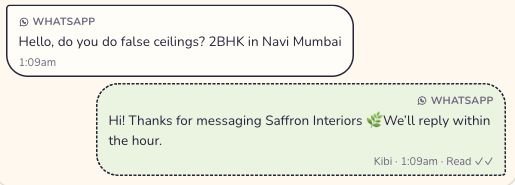
Sameer’s question is saved in the conversation. The acknowledgement underneath is not Ravi’s completed follow-up. Read this screen at full size
On a small screen, swipe inside the image to see the rest.
Keep the draft quote on that enquiry
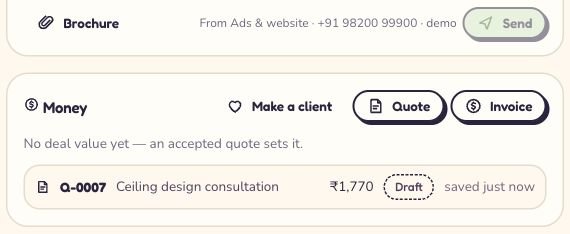
Q-0007 is saved on Sameer’s enquiry. The price is for the fictional consultation. Read this screen at full size
On a small screen, swipe inside the image to see the rest.


Once it’s sent, don’t start a second conversation in your head.
Record which quote went out, who owns the reply and any review date you agreed. A sent email tells you that you sent it. It does not tell you that the customer read or accepted it.
If they ask about scope, answer that. If they need a colleague’s approval, find out what would help. If they go quiet, choose a useful follow-up rather than sending this first email again.
When the answer is yes, use your agreed acceptance and delivery process. If an invoice is the next step, keep its payment conversation separate from asking whether they want the work.
A few questions before the quote makes its entrance.
How do I write an email for sending a quotation?
Name the project, reference the request or conversation, link or attach the current quotation and summarise the scope. If you repeat a price, state its currency and tax basis accurately. Finish with one clear way to ask a question or proceed.
What is a good subject line for a quotation email?
Use a recognisable project and quote reference, such as “Quotation [number] for [project] — [business]”. If the offer is a revision or an estimate, say so. Avoid vague subjects that force the recipient to open the email just to identify it.
How do I email a revised quotation to a customer?
Identify the project and current quote version, link or attach that version, and summarise what was added, removed or left unchanged. Explain the actual effect on price, tax basis, timing and terms. Ask the customer to review the revised offer; a follow-up is a separate message after you have sent it.
Should I put the quotation price in the email?
A short price summary can be useful when it is accurate and easy to explain. Match the current quotation’s total, currency, tax basis and relevant conditions. Link to the detailed offer rather than presenting an incomplete amount as the full project cost.
Can I say “please find attached” in a quotation email?
Yes, when the correct file is attached. Give it context: identify the project, summarise what the offer covers and explain the next step. “Here’s your quote for [project]” is a natural alternative, not a rule that formal wording is wrong.
What is the difference between a quotation email and a request for quotation?
A request for quotation asks a supplier for a price: describe what you need, the relevant scope or quantities and when you need their response. A quotation email sends the supplier’s offer back. The four templates here are for sending that offer; they are not procurement requests or tender documents.
Can I use the same email for a quote and an estimate?
Adapt the wording to the actual document. If you are giving an estimate while details remain unknown, identify it as an estimate and explain the assumptions and next checks. Use your approved terms and local requirements rather than treating the labels as interchangeable.
Will Kibi send these exact email templates automatically?
No. These are editorial examples to adapt. Kibi provides quotes with customer acceptance on every plan and Today for planning human next actions. Your team chooses the message, checks the details and carries out the follow-up.
Can two colleagues prepare and follow up the same quotation without losing the latest version?
Keep one current quote reference, the customer’s latest scope question and the person replying on the enquiry. In Kibi, the quote stays with that record and Today holds the planned human follow-up. Update the agreement when a colleague takes over; sending the initial offer and following it up remain different jobs.
Asking for a quote? Give the supplier something to work with.
If you came here to request a price, start with the service or items you need, useful quantities or scope, any timing or delivery constraints and a sensible reply date. Ask what the price includes.
You can keep that first request short. The supplier may need a conversation before pricing it. Once you are the business sending the offer back, the templates above take over.
About the examples. And the useful small print.
The four emails, annotated message and agency scenario are original, illustrative Kibi editorial examples. They are not customer results, tested conversion winners or legal templates.
Official quoting references were rechecked on 6 November 2026. They inform the preparation checklist; use the terms, tax treatment and acceptance process appropriate to your business.
You bring a clear offer and a little personality. Kibi helps the next conversation stay with the enquiry. A much nicer arrangement than asking the sent folder to flirt back.
Try one thing on the next enquiry.
Pick a change your team can use tomorrow.